
The seasons form a cycle often called the Wheel of the Year. Rather than moving in a straight line, time is seen as a circle that turns again and again. Each season carries its own character. Times of growth, harvest, rest, and renewal… and together they remind us of the natural rhythms of life.
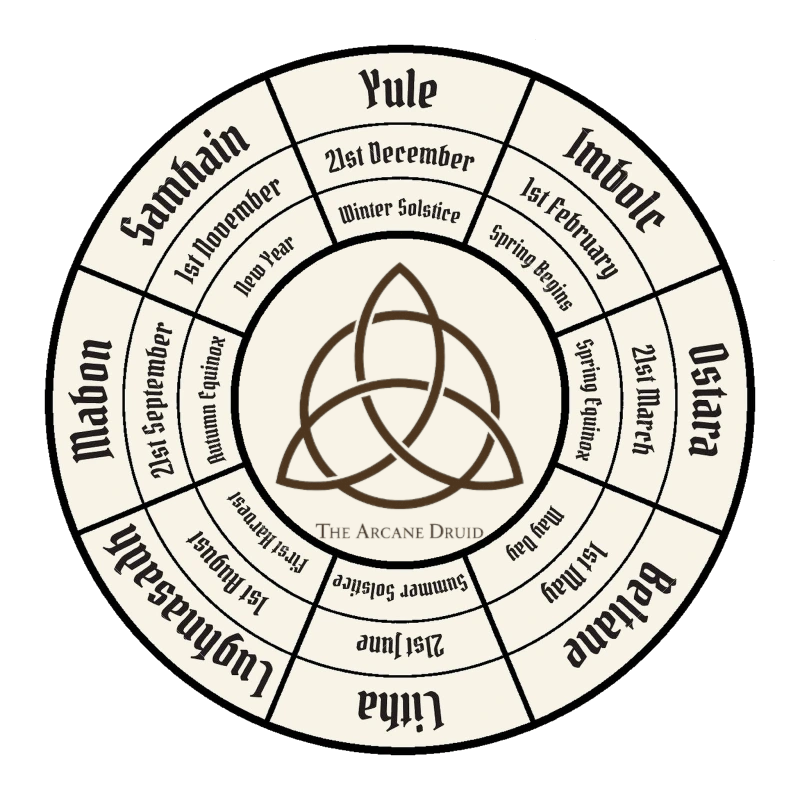
This cycle is marked by eight festivals. The solstices and equinoxes show the sun’s great turning points, while the cross-quarter days (Imbolc, Beltane, Lughnasadh, and Samhain) mark the transitions in between. These moments create a calendar that connects us with the light of the sun, the patterns of the land, and the work of our own lives.
In modern druidry, walking the Wheel of the Year can be as simple as noticing the changes around you like the length of the days, the feel of the air, the shift in energy. Or it can be as involved as holding seasonal rituals and celebrations. However it’s observed, the wheel offers a way to live in step with nature and find meaning in the turning of time.
December 21 – March 20
March 20 – June 21
June 21 – September 22
September 22 – December 21
The modern Wheel of the Year is a relatively recent synthesis, born from the intersection of folklore, agrarian custom, and twentieth-century pagan revival. While often presented as an ancient Celtic calendar, its eightfold structure which consists of the solstices, equinoxes, and the four traditional fire festivals, was first articulated in the mid-20th century by Gerald Gardner and Ross Nichols. Both men, active in the early Wiccan and Druidic movements, sought to reconstruct a ritual calendar that reflected the natural rhythms of the British Isles. By aligning the agricultural festivals (Samhain, Imbolc, Beltane, and Lughnasadh) with the solar events recognized in other European traditions, they created a unified cycle emphasizing balance and continuity throughout the year.
Historically, the ancient Celts and other pre-Christian peoples did not follow a standardized eightfold calendar. Archaeological evidence and early texts suggest that the four fire festivals were of particular importance among Celtic-speaking cultures, marking transitions in the pastoral and agricultural year. Samhain marked the end of the harvest and the beginning of the dark season; Imbolc heralded the first stirrings of spring; Beltane celebrated fertility and protection of livestock; and Lughnasadh honored the first fruits of the grain harvest. Meanwhile, monuments such as Stonehenge, Newgrange, and Callanish demonstrate a broader European awareness of the solar turning points, the solstices and equinoxes, though these were not necessarily linked to the same ritual framework.
The eightfold Wheel, as it is known today, represents an effort to harmonize these distinct seasonal observances into a single spiritual system. This integration reflects both romantic-era fascination with ancient Europe and the ecological spirituality emerging in the modern age. The Wheel’s cyclical symbolism mirrors agricultural, astronomical, and psychological cycles alike, a model of renewal, transformation, and return. While its exact form may be modern, its essence draws deeply from humanity’s long-standing dialogue with the land and sky. In this sense, the Wheel of the Year functions as a bridge: connecting reconstructed pagan heritage with contemporary understandings of ecology, ritual, and seasonal consciousness.