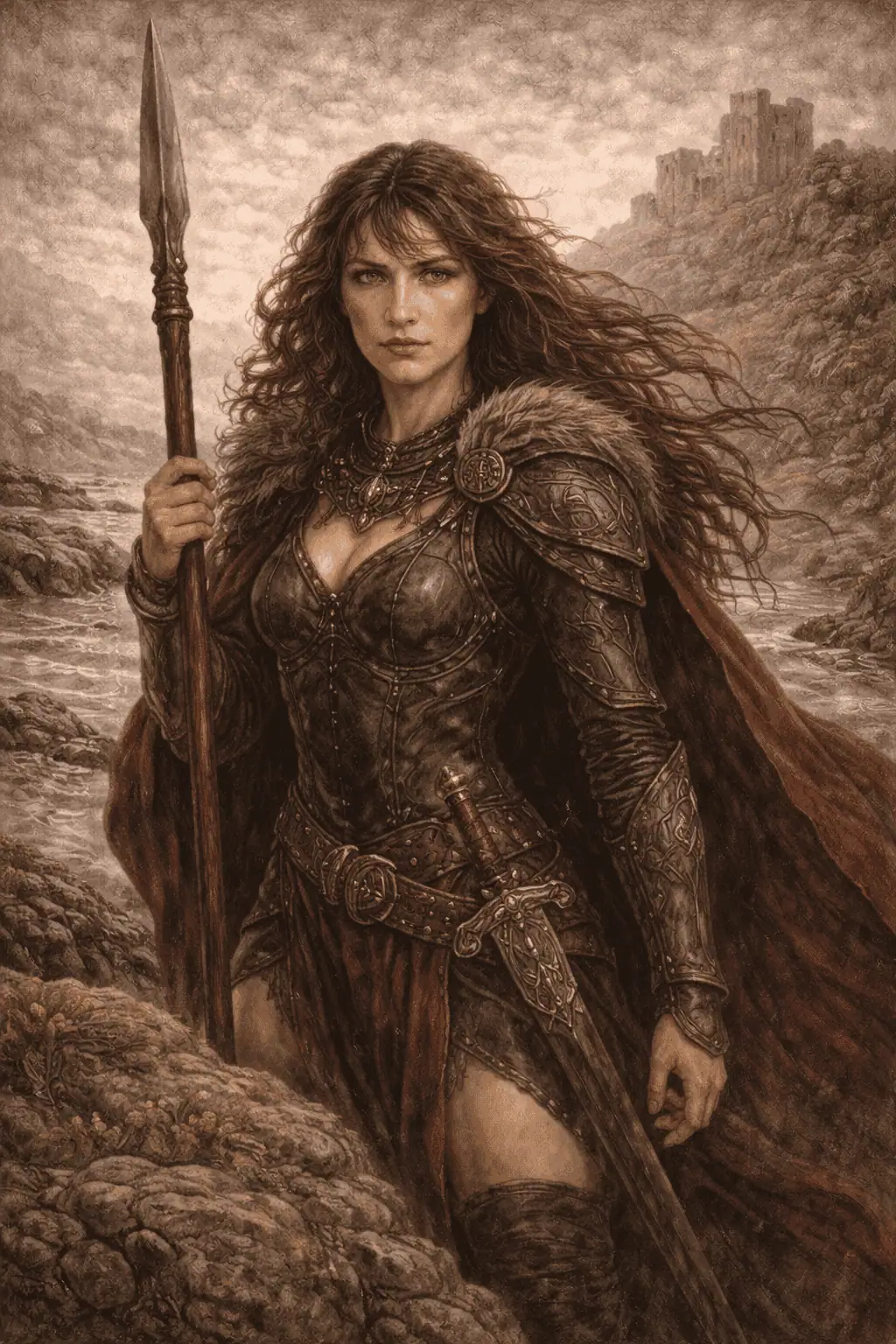
Scáthach occupies a distinctive place in Irish and Scottish myth as a figure defined less by divine authority than by mastery earned through ordeal. She is best known as the martial instructor of Cú Chulainn, the central hero of the Ulster Cycle, yet her importance extends beyond her most famous student. Scáthach represents a model of knowledge transmission that is demanding, dangerous, and uncompromising, rooted in the belief that transformation requires risk.
Medieval sources place Scáthach beyond the familiar boundaries of society. Her stronghold is described as lying across perilous waters or at the edge of the known world, often identified with Alba, sometimes mythically located rather than geographically fixed. This placement is not incidental. Scáthach’s domain exists in a liminal space where ordinary rules no longer apply, and those who seek her instruction must first survive the crossing. Entry itself functions as an initiatory trial.
Unlike later romanticized warrior women, Scáthach is not portrayed as a symbol of rebellion or spectacle. She is an authority figure whose legitimacy comes from experience, skill, and tested competence. Her instruction is not freely given. Students must endure hardship, humiliation, and fear before receiving her knowledge. This dynamic reframes mentorship as a process of controlled exposure to danger rather than protection from it.
Her most famous pupil, Cú Chulainn, is sent to Scáthach after already proving himself formidable. Even so, she subjects him to rigorous training and ultimately teaches him the use of the gae bolga, a weapon whose effectiveness depends on precision, timing, and restraint. The lesson is not merely technical. Mastery carries responsibility, and power misused leads to destruction.
Scáthach’s rivalry with Aífe further underscores her role as a figure of boundaries and consequence. Their conflict is not framed as moral opposition but as a clash of equals within a shared martial framework. The narrative emphasizes that strength alone is insufficient without discipline and judgment, qualities Scáthach embodies and enforces.
From a historical perspective, Scáthach is best understood as a legendary or mythic figure rather than a deity in the strict sense. She does not receive cultic worship in surviving evidence, nor is she associated with temples or inscriptions. Her authority is narrative, not institutional. However, her role fulfills a function often associated with divine or semi-divine figures: the gatekeeper of transformation through ordeal.
In modern interpretation, Scáthach is sometimes framed as a goddess or archetype of feminine power. While this reading can be meaningful in contemporary practice, it risks flattening her complexity if divorced from her original context. In the medieval texts, her power is not symbolic. It is practical, earned, and dangerous. She does not empower indiscriminately; she tests.
Scáthach ultimately represents a worldview in which growth is not safe, wisdom is not gentle, and mastery is never free. Her lessons are simple but unforgiving: face fear directly, accept consequence, and understand that skill without integrity is ruinous. In this sense, she stands as one of the clearest expressions of the Celtic heroic ethic, where transformation is paid for in blood, endurance, and resolve.