
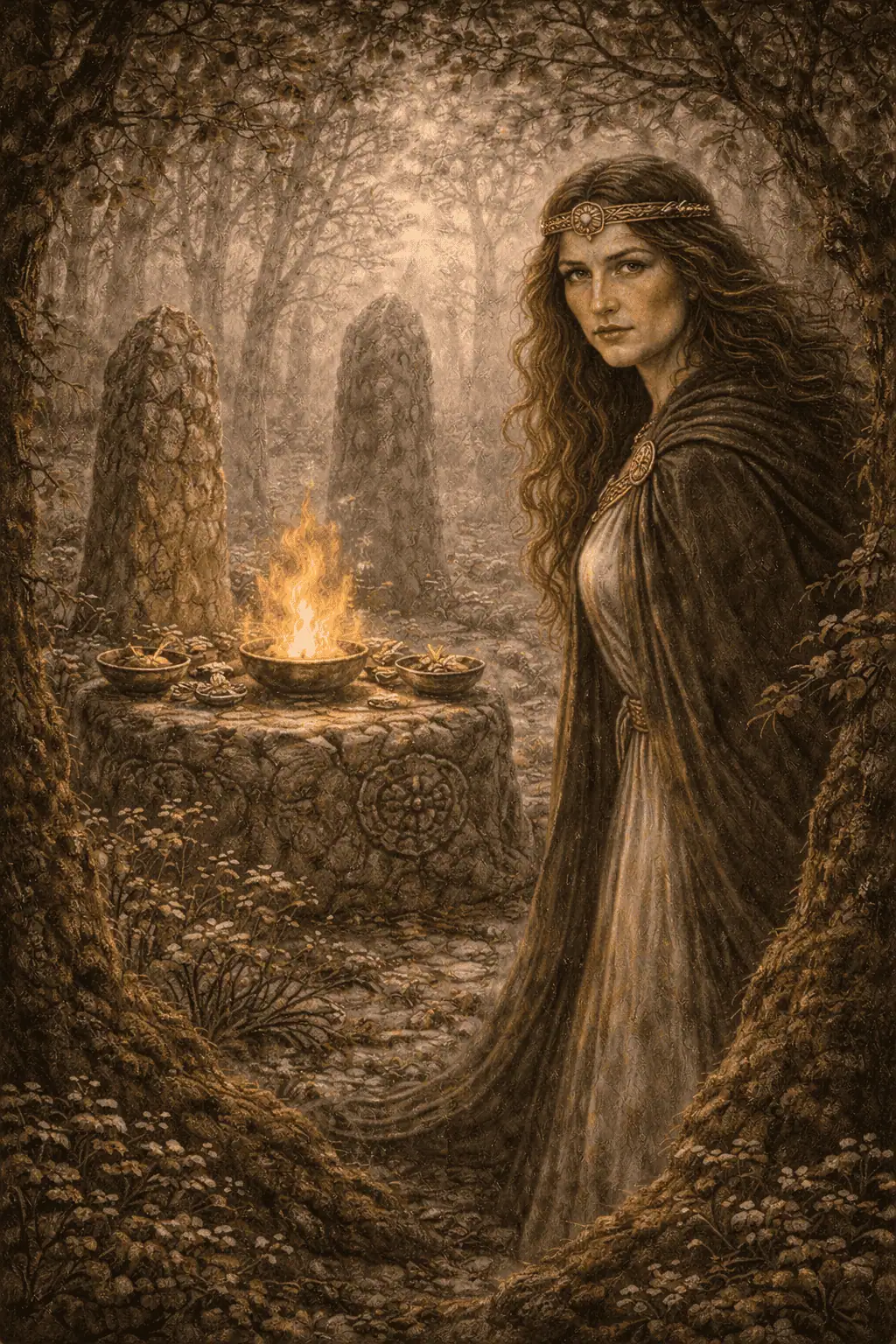
Nemetona is a Gaulish deity whose significance lies not in narrative myth or personal legend, but in function. She is associated with the nemeton, a sacred grove or ritually defined space used for religious practice in the Celtic world. Unlike deities known primarily through stories, Nemetona is known through place, inscription, and structure.
The nemeton was not simply a forest or natural clearing. It was land set apart through human intention and religious act. Boundaries mattered. Entry mattered. Activity within the space was governed by expectation and restraint. Nemetona embodies this distinction between ordinary ground and sacred ground, serving as the divine presence that marks and maintains it.
Evidence for Nemetona comes primarily from Romano-Gaulish inscriptions, where her name appears in dedicatory contexts. These inscriptions often pair her with Mars, reflecting Roman interpretive frameworks rather than original Celtic theology. In these cases, Mars likely represents a localized protector or guardian of territory rather than a god of warfare in the classical Roman sense. Nemetona’s role within this pairing remains consistent: she anchors the sacred character of the land itself.
Importantly, Nemetona does not appear as an active agent in mythic narratives. She does not intervene, instruct, punish, or reward in story form. This absence is instructive rather than limiting. Her presence is spatial rather than dramatic. She exists where ritual happens, not where heroes act.
This makes Nemetona particularly valuable for understanding how religion functioned at a communal level. While many deities express values through story, Nemetona expresses meaning through arrangement. She governs the conditions under which ritual is possible. Without a nemeton, there is no formal meeting between human and divine. In this sense, her role precedes all other religious activity.
From a historical perspective, Nemetona reflects a deeply practical theology. Sacredness is not abstract or universal. It is made, maintained, and respected. The grove is sacred because it is treated as such, and Nemetona embodies that collective agreement.
In modern contexts, Nemetona is sometimes generalized into a goddess of nature or forests. While understandable, this interpretation risks diluting her specificity. She is not associated with wild land indiscriminately. Her domain is defined space, intentionally set apart. The difference is subtle but crucial.
Nemetona ultimately represents a worldview in which the sacred is not everywhere, but it is accessible wherever humans take responsibility for creating and honoring it. Her presence reminds us that ritual begins not with words or offerings, but with boundary, intention, and place.