
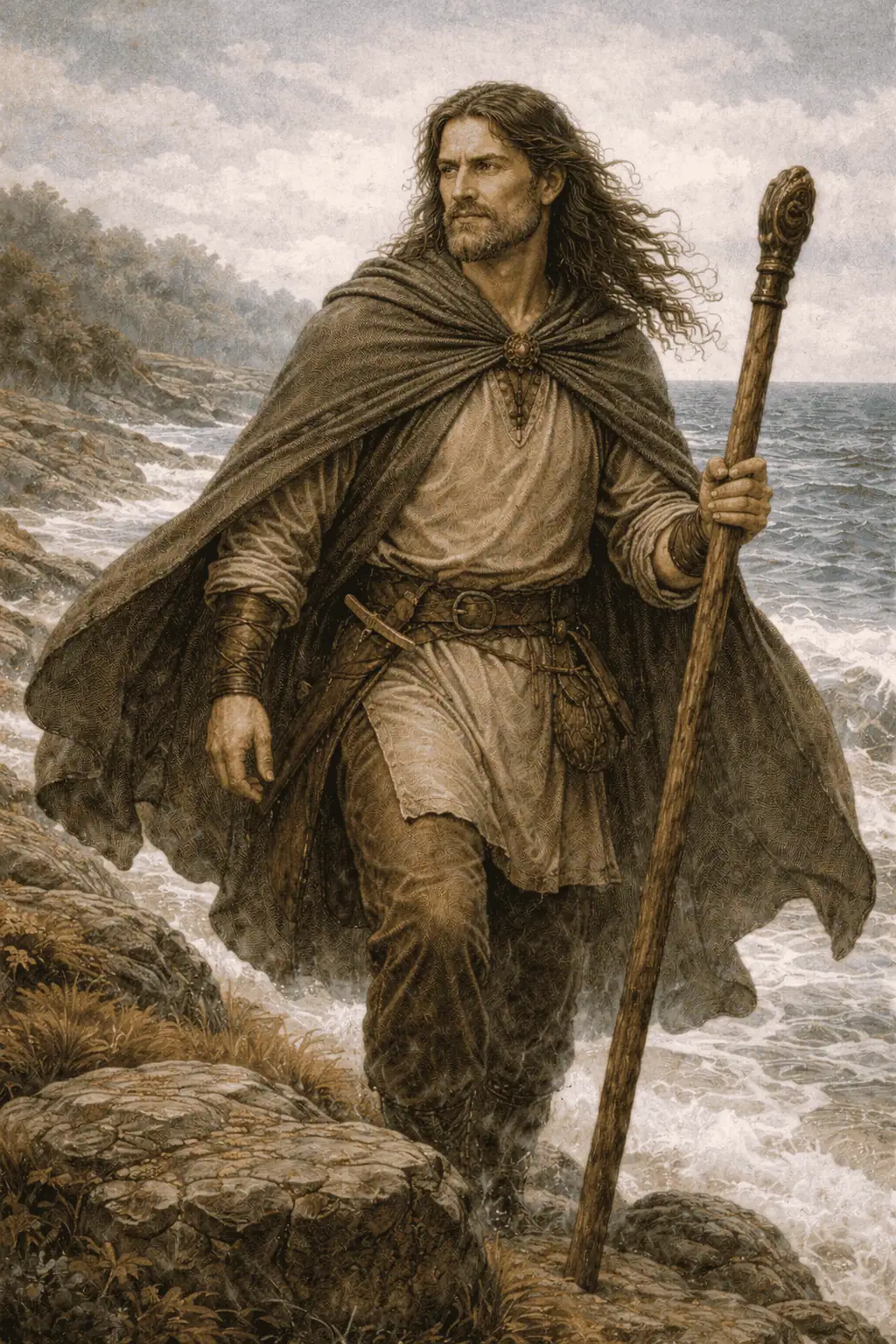
Manannán mac Lir is one of the most consistently attested and conceptually coherent deities in Irish mythology. Unlike many figures whose roles shift across sources, Manannán maintains a stable identity as a ruler of the sea, a guardian of boundaries, and a mediator between the human world and the Otherworld. His authority is not expressed through domination or violence, but through control of movement, perception, and access.
As his patronymic indicates, Manannán is the son of Lir. However, the contrast between father and son is instructive. Where Lir embodies the sea as endurance and loss, Manannán represents the sea as governed space. He does not merely exist within the maritime world; he organizes it. He controls passage, grants or denies safe travel, and determines when the boundary between worlds may be crossed.
Manannán is frequently associated with the Otherworld, often described as ruling realms such as Emain Ablach or presiding over islands concealed by mist. These locations are not presented as distant heavens or underworlds, but as adjacent realities that overlap with the human world under specific conditions. Manannán’s power lies in managing this overlap. He uses illusion, concealment, and timing rather than force, reinforcing the idea that access to deeper knowledge or blessing must be mediated and earned.
In narrative tradition, Manannán often appears as a guide or benefactor to heroes and kings. He provides magical items, safe passage, or instruction, but rarely intervenes directly in conflict. His gifts, such as the self-navigating boat Scuabtuinne or weapons that ensure victory when used rightly, come with implied responsibility. The recipient must act within proper bounds. Manannán’s favor does not remove consequence; it clarifies it.
This emphasis on order and boundary is central to his role in sovereignty traditions. Manannán is not himself a king of Ireland, but he supports and legitimizes kingship by maintaining the conditions under which rule is possible. He ensures that land, sea, and Otherworld remain in balance. When that balance is disrupted, it is often Manannán who restores it, not through conquest, but through correction and withdrawal.
Importantly, Manannán’s authority extends beyond the sea in a narrow sense. While he is clearly a maritime deity, his dominion includes roads, borders, and transitional states more broadly. He governs movement between places, conditions, and phases of life. This makes him a liminal deity in function, though not in the initiatory sense seen with figures like Scáthach. Manannán does not test through ordeal; he regulates through structure.
From a historical perspective, Manannán is well embedded in medieval Irish literary tradition, appearing across multiple cycles and texts. His prominence suggests a deity whose conceptual role remained useful and intelligible over time. Unlike deities tied tightly to localized cults or singular myths, Manannán operates at the level of systems: navigation, kingship, hospitality, and the maintenance of cosmic order.
In later folklore and modern interpretation, Manannán is sometimes softened into a benevolent trickster or romanticized sea spirit. While these portrayals draw on real elements of illusion and play, they risk obscuring his core function. Manannán is not chaotic. His use of deception serves clarity, not disruption. Illusion exists to preserve boundaries, not erase them.
Manannán mac Lir ultimately represents a vision of power rooted in restraint and governance. He does not overwhelm the world with force, nor does he withdraw into passive endurance. Instead, he stands at the crossings, ensuring that movement, exchange, and transformation occur according to rule and season. In a mythological landscape often dominated by conflict and fate, Manannán offers a model of authority grounded in balance, responsibility, and deliberate action.