Lugh is one of the most radiant and compelling figures in the Irish mythological tradition: a master of many arts whose brilliance touches craft, strategy, sovereignty, and creative skill. He is remembered as the young champion who arrives at exactly the right moment, the one who knows how to do what must be done. Beginners can think of him as the embodiment of skill brought to purpose, the spark of inspiration that becomes real through mastery.
In Old Irish sources, Lugh (Lugh Lámfada, “Long-Arm”) is counted among the Tuatha Dé Danann, though his lineage bridges two worlds: his father Cian comes from the Tuatha, while his mother Ethniu is of the Fomorians. This dual heritage places him at the meeting edge of order and chaos, and many stories emphasize how he brings balance, coordination, and clarity in moments of strain. His name is often linked to ideas of “oath,” “binding,” or “light,” and cognates appear across the Celtic world, including the pan-European god Lugus.
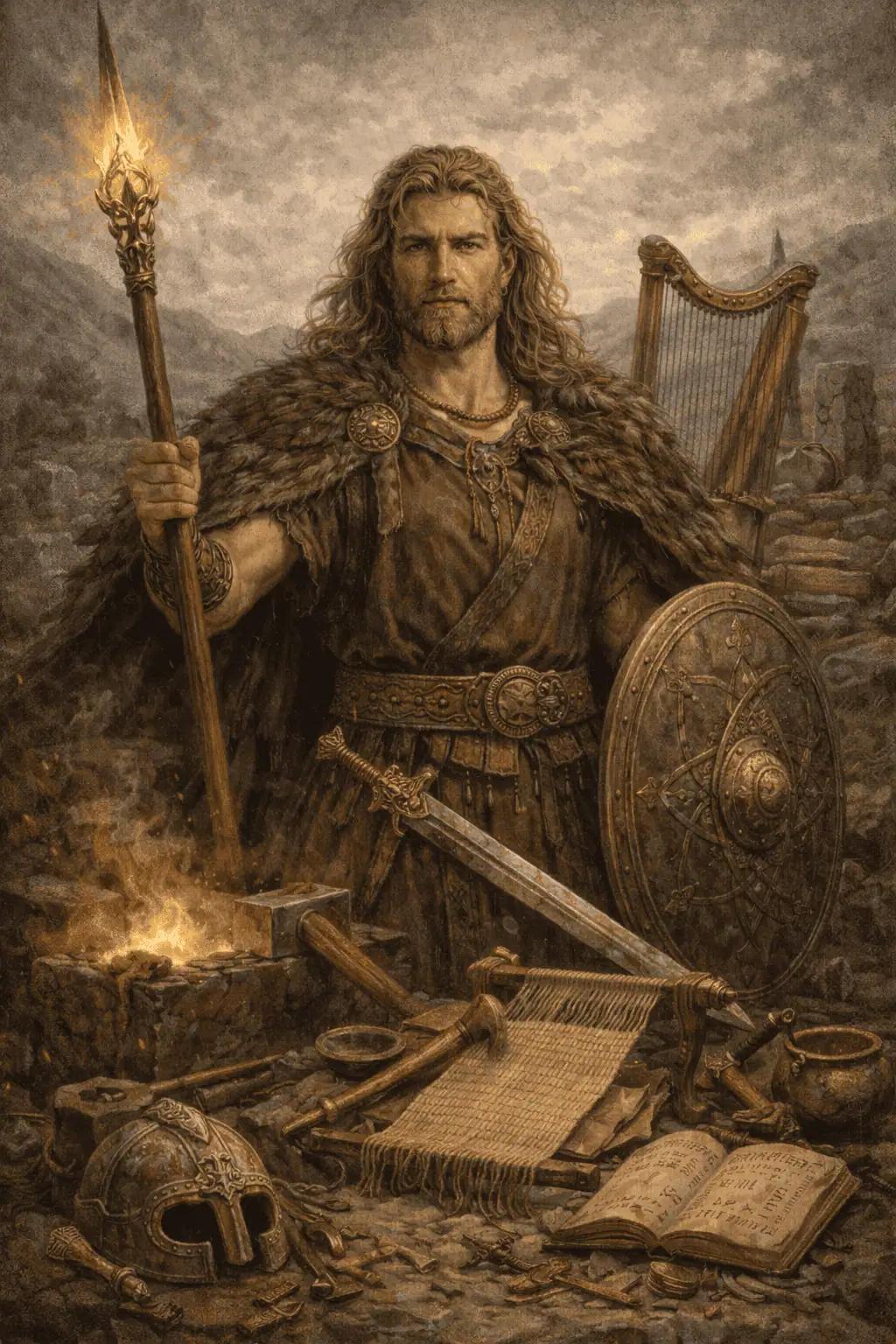
Lugh’s gifts are famously many. In the tale of his arrival at Tara, he is refused entry until he declares each art in which he excels, smithcraft, healing, poetry, wrighting, sorcery, and more, none of which the court needs, until he asks: “Yet do you have one who masters all these together?” This moment establishes him not as a jack-of-all-trades, but as the principle of integrated excellence: the one who unites many disciplines into a single, effective whole.
In story, Lugh shines brightest in the Second Battle of Mag Tuired. The Tuatha Dé Danann stand against the oppressive Fomorian forces, and Lugh becomes the pivotal warrior who defeats his own grandfather Balor, a monstrous king whose evil eye brings death. By slaying Balor, Lugh overturns a legacy of destruction and restores vitality to the land. This act echoes through the festival that bears his name, Lughnasadh, the threshold of harvest in early August. In tradition, games, gatherings, and first-fruit offerings honor Lugh and the labor, skill, and communal strength that bring a harvest to fruition.
Lugh’s domains form a pattern that speaks to many modern practitioners: craftsmanship, artistry, protection, leadership, and the disciplined use of talent. He is often associated with the spear (a symbol of precision and intention), the long arm that reaches where others cannot, and the guiding light of high summer. He is not a remote or aloof deity; in the tales, he works alongside others, teaches skills, and brings coordination to a community of powers.
Why is Lugh important? Because he represents the moment when potential becomes mastery, when scattered abilities become focused, when skill is used in service of the people and the land. If you remember nothing else, remember that Lugh blesses the work of many hands brought together toward a shared purpose. For seekers at the beginning of their path, honoring Lugh can be as simple as choosing one craft or skill to develop with intention, sharing your knowledge generously, and celebrating the efforts that sustain your community.
Across Ireland and beyond, Lughnasadh customs, athletic contests, hilltop gatherings, berry picking, and first-harvest rites, preserve the sense that Lugh stands at the height of the year, illuminating both the gifts we have cultivated and the work still ahead. He remains a patron of artisans, leaders, strategists, and anyone striving to bring their many talents into harmony.