
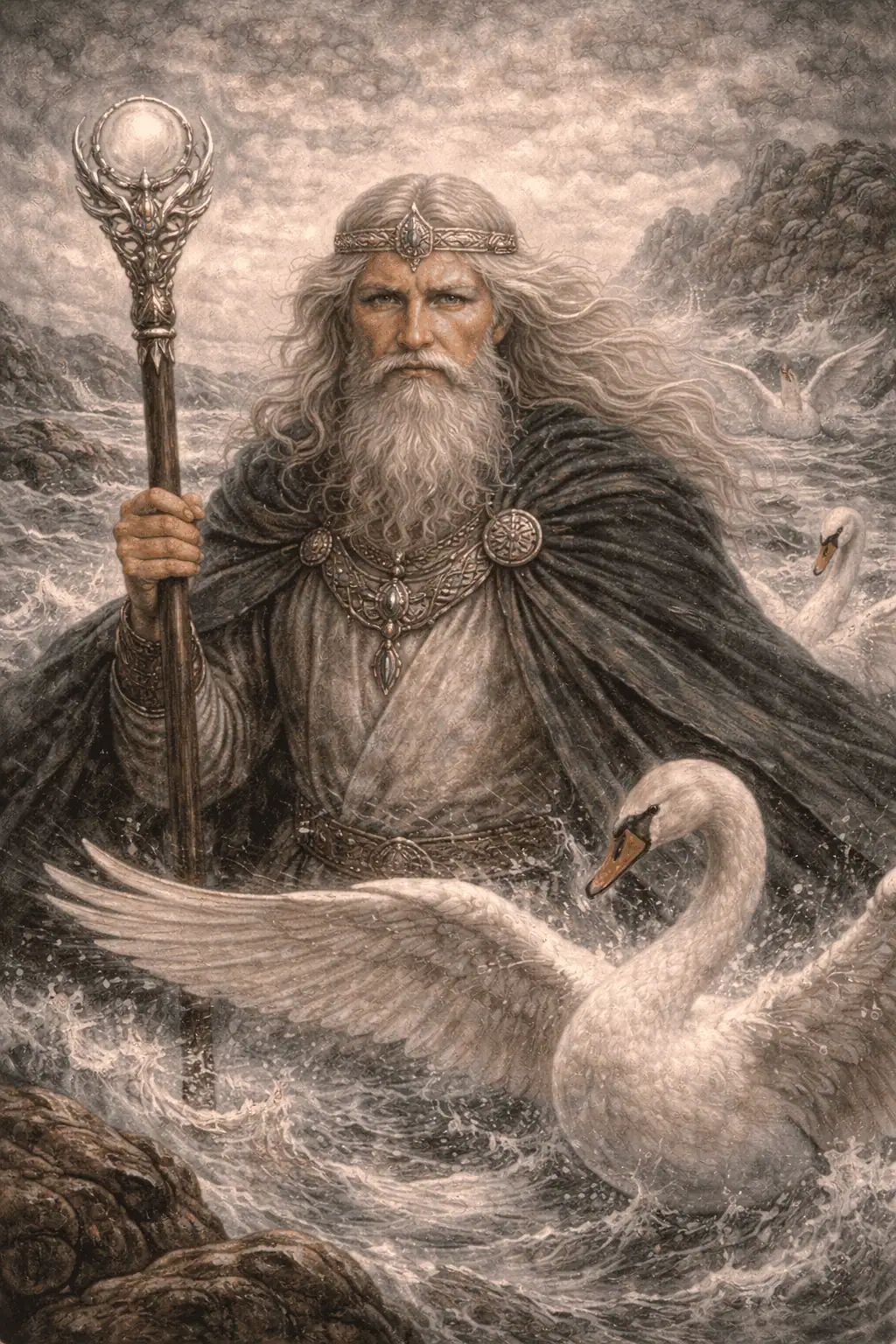
Lir occupies a restrained but significant position in Irish myth. Unlike many deities whose identities are defined by power, rulership, or repeated heroic action, Lir is remembered primarily through narrative consequence. His presence establishes the sea not as a realm to be mastered, but as a vast, enduring force within which human suffering unfolds.
Lir appears in medieval Irish literary tradition as a figure of noble standing whose life is marked by profound personal loss. His most enduring association is with The Children of Lir, a tale that centers not on triumph but on endurance across time. In this narrative, Lir’s children are transformed into swans and condemned to centuries of wandering across Ireland’s waters. The story spans generations, emphasizing the slow passage of time and the indifference of the natural world to individual grief.
Notably, Lir does not reverse this curse, nor does he reclaim authority through force or magic. His role is defined by endurance rather than intervention. This distinguishes him sharply from later or more active sea deities, including his son Manannán mac Lir, who commands the sea through illusion, navigation, and sovereignty. Where Manannán governs, Lir endures.
From a mythological standpoint, Lir represents an older or quieter conception of the sea. He is not a god of storms, voyages, or wealth, nor does he protect sailors or grant favor. Instead, he embodies the sea as an emotional and temporal reality: vast, impartial, and capable of holding sorrow without resolution. His myths suggest that some forces cannot be negotiated with, only survived.
The relative scarcity of direct cultic evidence for Lir supports this interpretation. He is not attested through inscriptions or archaeological material, and his presence is almost entirely literary. This does not diminish his importance but clarifies it. Lir functions as a narrative anchor rather than a ritual focal point, grounding stories of transformation, exile, and loss within a natural landscape that outlasts human lives.
In this way, Lir serves as a counterbalance within Irish mythology. He reminds the listener that not all power is expressive or active, and not all divinity intervenes. Some forces simply remain. The sea remembers, even when those who suffer upon it are forgotten.