
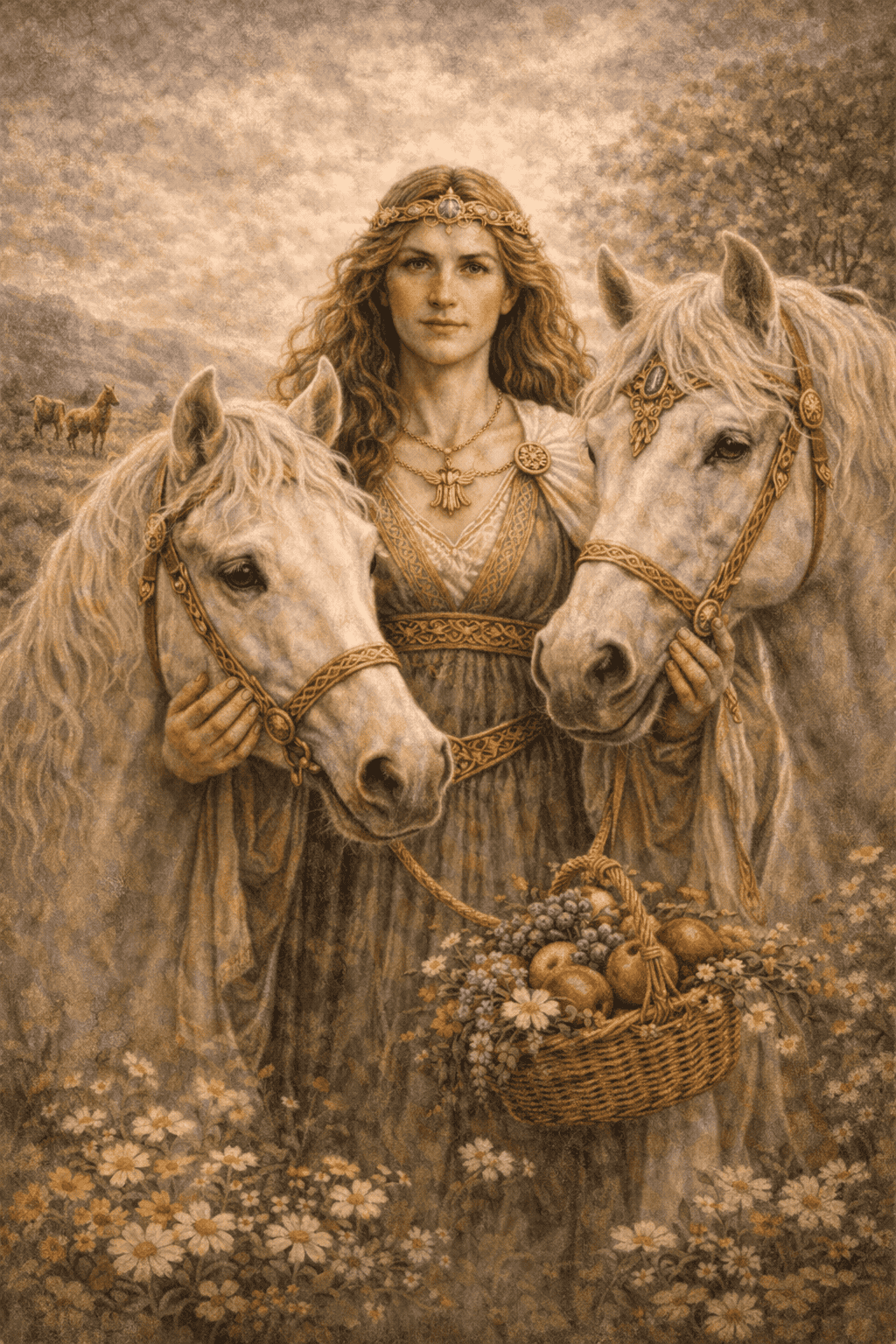
Epona is the great horse goddess of the Gaulish and Romano-Celtic world, revered by cavalry units, travelers, merchants, and ordinary households across a vast territory. Her name derives from epos, “horse,” and her images appear on carved stones from Britain to the Danube. Unusually among provincial deities, her cult was adopted across the Roman Empire, suggesting an appeal that crossed languages and borders: where movement mattered, Epona mattered.
Iconography shows her seated or riding, sometimes with a foal at her knee, and often holding a cornucopia or libation dish. The message is practical and tender. Epona protects the animals that carry our livelihoods and blesses the roads that connect our communities. In an age when horses were engines of communication and power, a goddess who guarded their health was central to prosperity. Today, her care translates easily: humane treatment of working animals, safe travel, attention to maintenance and rest, and gratitude to those,human and non-human,who bear our burdens.
Epona’s sanctuaries were built near stables and waystations, and her household shrines watched over routine journeys. To honor her now, offer apples or oats, donate to equine rescue or therapy programs, choose safer driving habits, or bless the vehicle that serves your household. Freedom of movement is a sacred trust.
Comparatively, Epona stands in friendly conversation with Welsh Rhiannon, who carries sovereignty on a white horse, and with Cernunnos, whose wild wealth complements Epona’s domesticated abundance. None of these equivalences are simple identities, but each reveals the Celtic intuition that right relationship with animals sits at the heart of human flourishing.
Keep this picture with you: a calm mare and her foal, the road stretching ahead, and a traveler who remembers to say thank you. Under Epona’s patronage, motion becomes not just a way to get somewhere, but a covenant of care for those who make the going possible.