
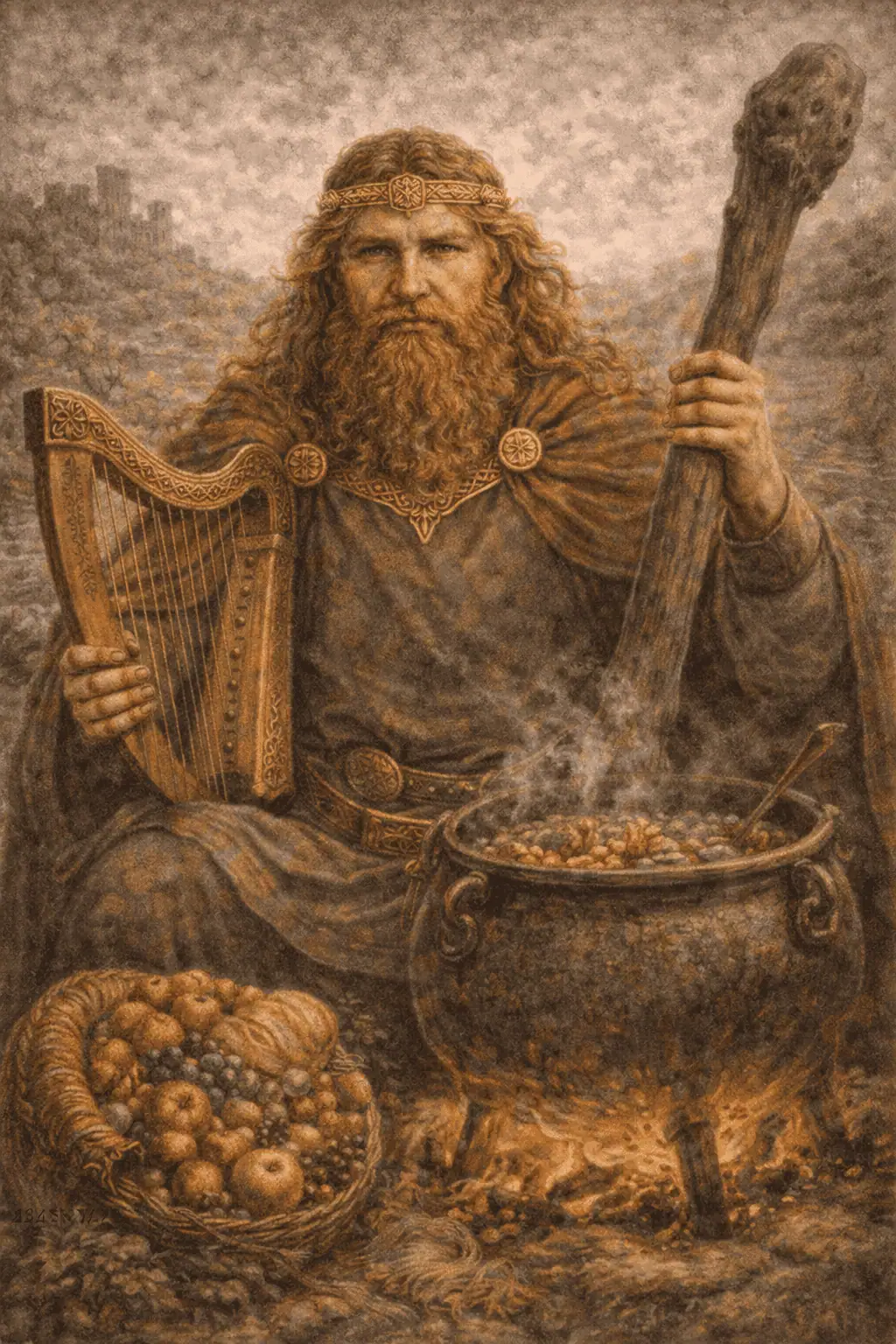
The Dagda is the jovial powerhouse of the Tuatha Dé Danann: a kingly figure whose gifts are abundant and whose appetite is legendary. His name is commonly explained as “good god,” meaning not morally perfect but supremely capable. He feeds the people from a cauldron that never empties, wields a club that can kill with one end and restore life with the other, and plays a harp that commands the seasons to move in their proper order.
If Brigid is the warm hearth, the Dagda is the feast that fills the hall. Hospitality is his signature virtue. In stories he welcomes, feeds, and restores; even his bawdy humor reflects a worldview where plenty is a blessing to be shared. As “Eochaid Ollathair,” the All-father, he stands as a paternal anchor for the Tuatha, wise in law and lore, yet ready for war when the community is threatened.
The Dagda’s relationships knit him tightly to other deities. He unites with the Morrígan on the eve of battle, a mythic pairing of sovereignty and strength that culminates in victory for the Tuatha. Many sources also name him as the father of Brigid, linking her inspired arts to his well of plenty. As for ancestry, the Dagda is frequently counted among the children of Danu, the matron whose name gives the Tuatha their own: literally, the “people of Danu.”
Why is the Dagda important? Because community thrives on shared resources and generous leadership. In modern practice, honoring the Dagda often means practicing hospitality , feeding friends, volunteering, or making sure no one is left out at the table. Music suits him, too: play the song that turns the year toward hope.
In the Second Battle of Mag Tuired, the Dagda’s might is both martial and cosmic. His harp is stolen and recovered; when he plays, it calls the seasons back into harmony with the world. This image is central: the Dagda as keeper of order through abundance, ensuring that the people are fed and the year turns rightly. For newcomers to Celtic lore, he’s an easy deity to recognize: large-hearted, larger-than-life, and absolutely on the side of the feast that restores the weary.