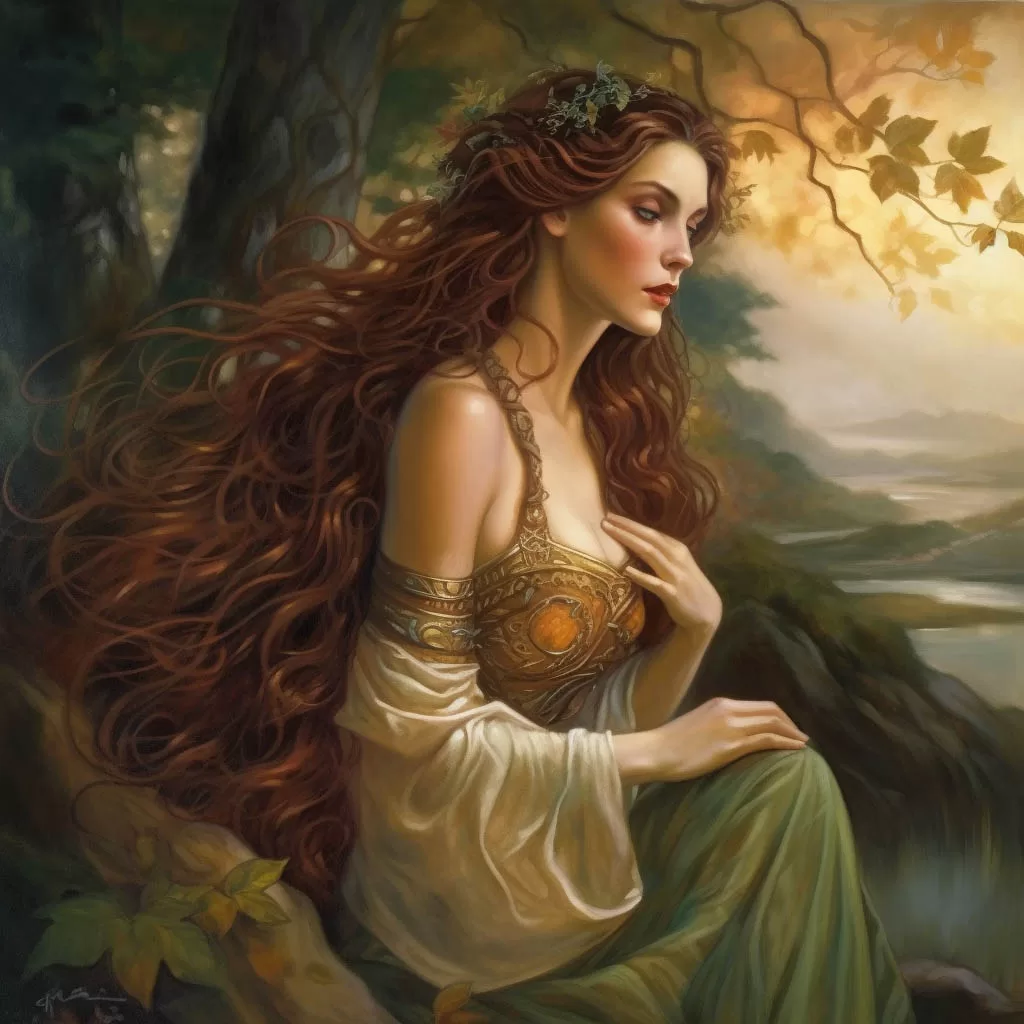
RhiannonOtherworld lady of horses, sovereignty, and steadfast endurance. Rhiannon chooses her own path, rescues her reputation with grace, and returns honor to her household. more... enters the First Branch of the Mabinogion with quiet thunder. Riding a white horse at a measured pace, she cannot be overtaken unless she wishes. When Prince Pwyll finally speaks to her, she answers without coyness: she has chosen him. This opening scene inverts courtly conventions,Rhiannon owns her agency,and it signals the themes that define her: sovereigntyThe principle of rightful authority grounded in balance and service. It ties leadership to harmony with the land and people. The concept stresses responsibility over..., patience, and a gracious endurance stronger than gossip or misfortune.
After her marriage, palace intrigue leads to the disappearance of her infant son. Courtiers, eager to shift blame, accuse Rhiannon of killing the child. She accepts a severe public penance: to sit at the gate and carry visitors into the hall like a beast of burden, all while telling the true story of what happened. She suffers this humiliation without surrendering dignity, and when the child,Pryderi,is later discovered alive, her honor is restored. The episode reveals Rhiannon’s peculiar strength. She does not crumble under slander; she trusts that truth, spoken steadily, will surface.
Symbols associated with Rhiannon include the white horse and a set of OtherworldThe Celtic spiritual realm intertwined with the mortal world. It is a place of ancestors birds whose song heals sorrow and ushers sleepers into restorative rest. She stands as a patron for endurance athletes, equestrians, and anyone rebuilding reputation after false accusation. Offerings can be practical: volunteering with animal care, choosing slower and more sustainable modes of travel, or setting personal boundaries that protect your pace and integrity.
Rhiannon’s sovereignty is personal as well as political. She models the capacity to choose one’s path and keep to it, inviting partners rather than captives. In this sense she resonates with figures like Manannán mac LirOtherworldly lord of the sea, ferryman, and giver of gifts. Manannán guides travelers between worlds and shelters heroes with hospitality that seems like a dream.... more... (as a guide across thresholds) and with Arawn, lord of AnnwnLord of Annwn, the Welsh Otherworld, who rules with justice and hospitality. Arawn tests character, rewards honor, and stands at the crossing between life and... more..., whose court prizes courtesy and justice. In comparative Celtic studies she is often placed beside the continental horse goddess EponaHorse goddess revered across Gaul and the Roman Empire. Epona protects riders and herds, blesses travel and fertility, and stands as a symbol of freedom... more... as a sister in equine dignity and freedom.
For beginners, Rhiannon offers a clear takeaway: sovereignty begins with the tempo you choose. Move at that pace even when others push. When rumor rises, do what she did,tell your story without frenzy, keep your seat, and let time prove you. In trying seasons, imagine Rhiannon turning her horse to face the road, calm as a tide; then ride on.