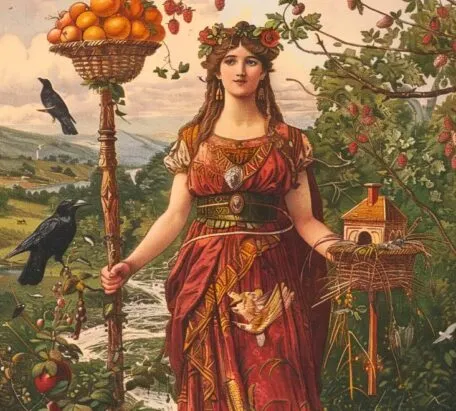
Among the pantheon of Gaulish deities, NantosueltaGaulish goddess of hearth and valley, renewal through tending, prosperity through seasonal care. more... stands apart as a quiet, sustaining presence. Where the war gods strike and the storm gods roar, she tends the steady pulse of life between battles, the warmth of hearth, the fertility of soil, and the humble abundance that keeps a people whole. Her name is thought to mean “winding stream” or “valley of the sun,” and she is most often depicted holding a small house or beehive-shaped shrine, symbols of home and domestic order. In a world where much of Celtic religion has been lost to the mists of conquest and time, Nantosuelta endures as the reminder that holiness is not only found in thunder or triumph, but also in the art of tending what is near.
In the archaeological record, Nantosuelta is most often paired with the god Sucellos, the mallet-bearing “Good Striker” who presides over plenty, wine, and the afterlife. Together, they form one of the most intimate divine pairings in Celtic iconography: he with his long-handled hammer and vessel, she with her house and raven. This juxtaposition, tool and dwelling, labor and rest, reflects the essential duality of life itself. SucellosThe Good Striker, mallet-bearing Gaulish god of abundance, wine, and the gentle protection of the dead. more... represents the vitality of work, craft, and sustenance, while Nantosuelta represents the space in which that vitality finds meaning. If he keeps the fire burning, she keeps the hearth that holds it. Their union reminds us that prosperity is not a matter of conquest or gain, but of rhythm, care, and reciprocityThe vital exchange and balance of energy between all beings and elements of nature. It underscores the principle of giving back to the life-force or... more... between work and home, death and renewal.
In this sense, Nantosuelta is a goddess of thresholds. The house she holds in her hand is not simply an emblem of domesticity, it is a shrine, a boundary between the chaos of the outside world and the ordered warmth within. She embodies the idea that care is sacred, and that the daily rituals of sweeping, mending, or sharing a meal are forms of worship in their own right. Many scholars interpret her connection with the raven as a sign of transformation and continuity: the scavenger bird that lives on what is past, ensuring that nothing of the old world is wasted in the creation of the new. In the natural cycle, she is the pulse of the seasons, the valley awakening after winter, the home renewed after hardship.
In a spiritual sense, to honor Nantosuelta is to return to simplicity. Her altarA sacred space where Druids and spiritual practitioners honor their connection to the natural world, ancestors, and deity. It typically features symbolic items such as... more... need not be elaborate; it might be the kitchen table, the first flower planted in spring, or the warmth of a shared meal. She blesses the work done quietly and well, the hands that mend clothes, the ones that cook for others, the ones that keep community intact. Her festivals would likely have been domestic, rooted in hospitality and gratitude. Even without surviving myths, her image suggests a theology of sufficiency: that a life well-lived is not one of endless striving, but of harmony with the world one inhabits.
In modern druidic or pagan practice, Nantosuelta speaks to those seeking balance in an overextended world. She is the reminder that spiritual renewal often begins in physical renewal, tidying the home, caring for the body, or restoring the neglected. Her presence sanctifies the small and the overlooked, the places where love lingers quietly. She invites reflection on what “enough” truly means, asking each of us to tend the thresholds of our lives, the doors we open, the fires we feed, the hearts we keep warm.
Through her, we learn that divinity resides not only in the sky or the sea, but also in the steady rhythm of human hands and the humble grace of daily life. Nantosuelta whispers that to care is to create, and to keep the hearth is to keep the world.