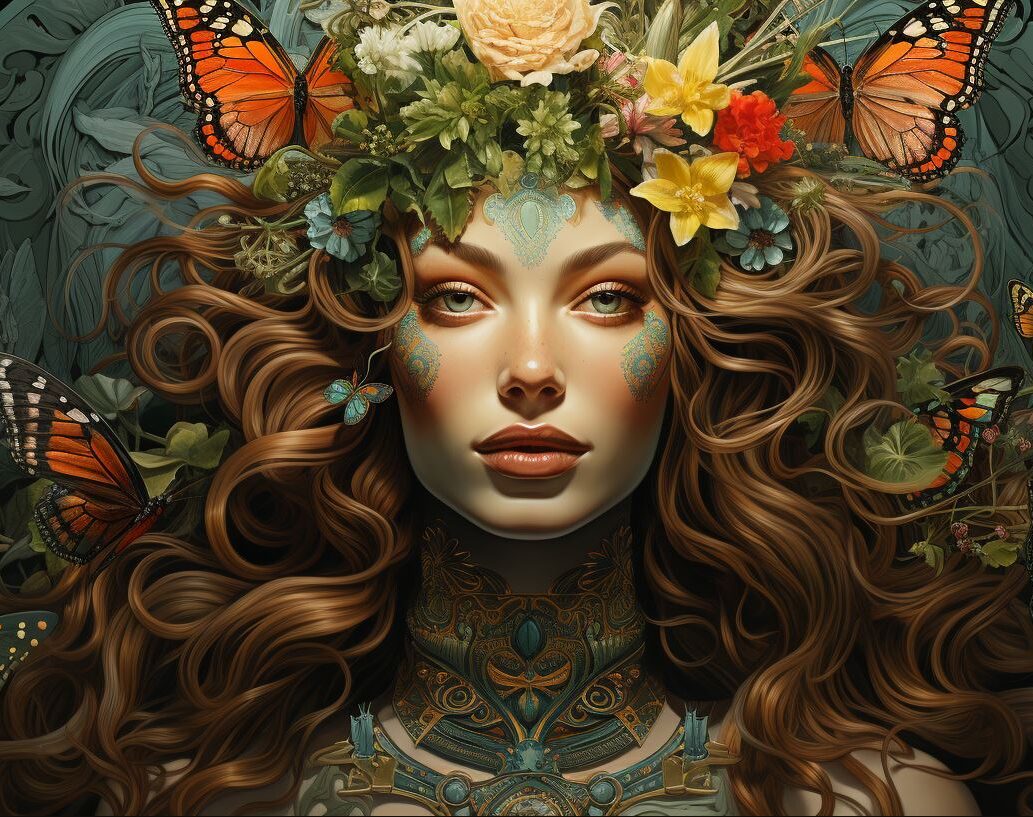
The figure of Modron, the “Divine Mother”, flows through Celtic mythology like an underground river, surfacing in Gaul as Dea MatronaDivine mother of Mabon (Maponos), Modron embodies the fertile, mysterious power that births and renews divine life. She represents both personal rebirth and the land’s... more..., in Britain as Modron, and in Cornwall as Madron, saint of holy wells. Though her myths are scattered, they converge in a single current: she is the source of renewal, the fertile mystery from which both gods and worlds are born.
In Gaulish inscriptions, Dea Matrona is invoked beside rivers and springs, her name gracing the River Marne and countless lesser streams. She is a goddess of nourishment, protecting both land and lineage. Her triple forms, the Matronae, watch over hearth and harvest, guarding mothers in childbirth and blessingA physical or verbal act that invokes divine energy to bestow protection, health, or good fortune upon a person, place, or event. In Druidry and... more... the fields. These images reveal her as both literal and symbolic: she is the land that gives life, the womb that bears both gods and people alike.
In Britain, her story deepens into mythic shadow. As Modron, she becomes the mother of Mabon, the child of light, stolen from her three nights after his birth and imprisoned in the underworld. Her grief is the world’s winter, her hope its spring. When Arthur’s men finally find and free Mabon, the tale becomes more than a rescue: it is a restoration of balance, a mythic reenactment of dawn returning after darkness. Through her loss and reunion, Modron teaches that even sorrow is fertile, that what is taken may one day return, transformed.
Unlike Brigid’s active flame or Danu’s cosmic vastness, Modron’s divinity is intimate, embodied, and patient. She governs the sacred processes of gestation and healing… both literal and spiritual. Her realm is the slow rhythm of care: the tending of children, the turning of soil, the daily acts that sustain existence. In her, the Celtic understanding of the sacred feminine reaches its fullest maturity, not as beauty alone, but as endurance, wisdom, and the ability to hold life through death and back again.
Devotion to Modron, whether ancient or modern, is not loud. It is the lighting of a hearth candle, the pouring of clean water, the planting of a seed. Her blessings move quietly, in recovered strength after illness, in the reconciliation of family, in the moment grief softens into memory. She is the mother of continuity, and her altarA sacred space where Druids and spiritual practitioners honor their connection to the natural world, ancestors, and deity. It typically features symbolic items such as... more... is wherever something is nurtured back to life.
In the Druidic imagination, Modron presides over the deep wells of being. To approach her is to descend into stillness… to face one’s own winter and trust the eventual thaw. She whispers that everything lost will one day be found again, not as it was, but as it must become. Her son’s story is her own: light returns because the mother never ceases to love.
To honor Modron is to remember that creation is not an act of conquest, but of care. She asks not for praise, but presence. For those who listen, she speaks through the sound of running water: a promise that beneath every grief, life still flows.