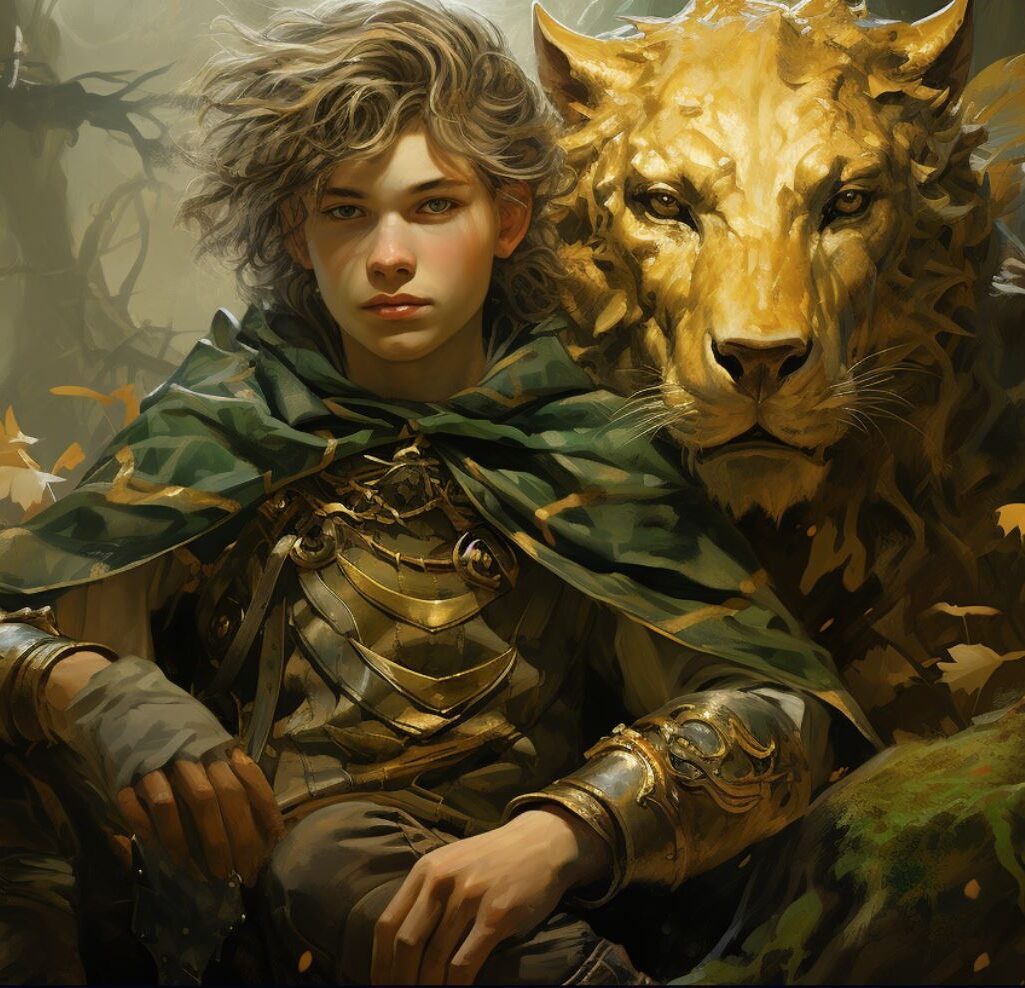
Among the gods of the Celtic world, few carry such a sense of luminous tenderness as Maponos, the “Divine Son,” the youthful god whose song spans the chasm between mortality and eternity. His name survives in weathered inscriptions along the Roman frontier and in the echoing cadences of medieval Welsh myth. Yet despite the centuries between them, the essence remains: Maponos is the bright breath of renewal, the voice that rises again after silence.
In Gaulish and northern British contexts, Deo Mapono appears beside healing springs and sacred groves. Pilgrims came not to conquer but to recover… health, hope, and the ability to begin again. The Romans saw him as akin to Apollo, patron of music and medicine, but beneath the Latin veneer lies something more intimate: a god who heals not through through song… He represents youth not as naiveté, but as creative power unburdened by cynicism… the original spark of inspiration that the world tries, again and again, to silence.
This theme deepens in his Brythonic reflection, Mabon ap ModronMabon ap Modron, “the Son of the Divine Mother”, is the youthful god of renewal, taken from his mother three nights after birth and imprisoned... more....Trickster-mage of the Mabinogi whose cleverness makes and unmakes fates. creator of Blodeuwedd and tutor of Lleu. more... In the Welsh Mabinogion, Mabon is the divine child stolen from his mother and imprisoned until Arthur’s men free him. The story resonates with the mystery of rebirth: creativity, like divinity, must descend before it ascends. To lose the child is to lose wonder; to recover him is to restore vision. Maponos, then, is the return of wonder, the recovery of one’s divine inheritance through courage, art, and remembrance.
In a spiritual sense, he invites practitioners to reclaim their creative voice. To sing, to write, to build, to love as these are acts of devotion to Maponos. You don’t need a temple to worship him, it is in the moments we resist despair and choose to make something beautiful. Like the sun that rises after the longest night, he renews faith in what can still be born.
Iconographically, Maponos often appears youthful, radiant, and musical, like a symbol of the soul’s eternal springtime. He may carry a harp or cup, sometimes accompanied by birds or flowing water. His presence near healing wells suggests that he governs not only the spirit’s rejuvenation but also the body’s, that music and medicine are kin. To honor him is to heal through harmony: song for the sick, kindness for the weary, words that mend instead of wound.
In devotion, Maponos asks for sincerity. Offer him music, poetry, or a simple hum beside running water. Dedicate your art to him — not to fame, but to wholeness. He stands with BrigidGoddess of healing, poetry, and craft; a bright, many-skilled patron of hearth and inspiration. Brigid bridges sacred fire and fresh water, blessing poets, healers, smiths,... more... at the hearth of inspiration, with OgmaGod of eloquence and strength, often credited with creating Ogham, the early Irish script. Ogma ties speech to power, showing how words bind, inspire, and... more... in the workshop of eloquence, with Aengus at the dawn of love’s promise. He is the son of the divine mother, the echo of every soul that remembers its song.
For modern druids, Maponos teaches that inspiration is not found, it is remembered. It is drawn up like a spring from the deep wells of the self. His gift is the eternal youth of the spirit, the renewal that arises each time we dare to sing again.