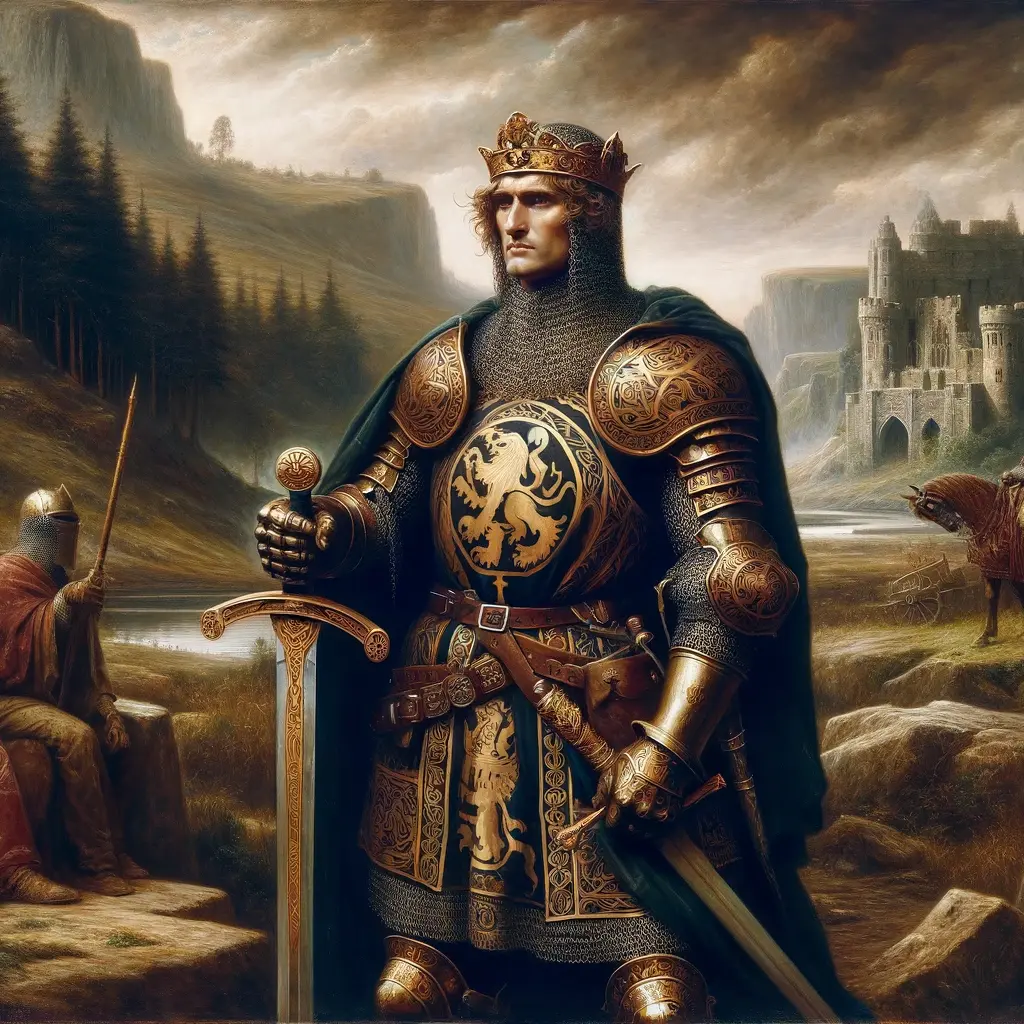
Mabon ap ModronMabon ap Modron, “the Son of the Divine Mother”, is the youthful god of renewal, taken from his mother three nights after birth and imprisoned... more..., “the Son of the Divine Mother,” stands as one of the most evocative figures in Welsh mythology. His story is brief yet haunting, a child stolen from his mother three nights after his birth, whose absence leaves the world dim until he is found again. Through this simple myth, the Welsh bards preserved a mystery as old as agriculture itself: the descent of light into the earth, and its eventual return.
In the Mabinogion tale of Culhwch and Olwen, Arthur’s warriors cannot complete their quest without freeing Mabon from his prison. They seek him by questioning the oldest living creatures, the Blackbird of Cilgwri, the Stag of Rhedynfre, the Owl of Cwm Cawlwyd, the Eagle of Gwernabwy, and finally, the Salmon of Llyn Lliw. Only the Salmon, oldest and wisest of all, knows where Mabon lies. Beneath Gloucester, in a watery cell, the divine youth waits to be reclaimed. His liberation becomes a symbol for the restoration of balance, the rekindling of creative power trapped in shadow.
Like many Celtic figures, Mabon’s myth bridges the personal and the cosmic. It is the story of an individual’s captivity, yet also the myth of winter’s confinement, of inspiration withheld, of the seed buried underground. When he is freed, it is not only one youth but all of creation that breathes again. Scholars see in this a possible echo of agricultural or solar deities whose withdrawal marks the dark half of the year. In this light, Mabon’s release becomes the dawn after the long night, the awakening of divine potential that was never lost, only hidden.
His connection to his mother, ModronDivine mother of Mabon (Maponos), Modron embodies the fertile, mysterious power that births and renews divine life. She represents both personal rebirth and the land’s... more..., deepens the mythic resonance. She is the archetypal womb, the matrix of creation, while he is the vitality that springs from it. Their separation mirrors the tension between matter and spirit, body and soul, and their reunion marks the moment when those forces realign. Modron’s lament for her lost child is the grief of nature in decline, but her hope sustains the world until his return.
Though his story occupies only a few lines in medieval text, its archetype endures. In the modern pagan calendar, “Mabon” names the autumn equinoxThe twice-yearly moment when day and night are equal in length. It represents harmony, balance, and renewal. Many traditions celebrate equilibrium and reflection during this..., the moment of balance between day and night. Whether or not the historical Mabon was ever linked to this festival, the symbolism fits: it is the time of descent and gratitude, when harvest is gathered and the light prepares to wane. The modern invocationThe formal calling upon a spirit of Mabon honors his role as a bringer of renewal, not by denying darkness, but by moving through it.
In devotion, Mabon calls for introspection and courage. To follow him is to accept descent as part of the cycle, to enter the shadow willingly, trusting that release will come. Offer him gratitude at the turning of the seasons; speak your own story of being lost and found. He is the youth who reminds us that even what is taken can be reclaimed, and that the soul’s true light is never extinguished, only waiting beneath the river’s skin to rise again.
Would you like me to follow this pattern next with ArawnLord of Annwn, the Welsh Otherworld, who rules with justice and hospitality. Arawn tests character, rewards honor, and stands at the crossing between life and... more... (to complement Mabon’s descent myth), or with Dylan ail Don, who shares the “divine youth of water” archetype but through a more elemental, oceanic lens?