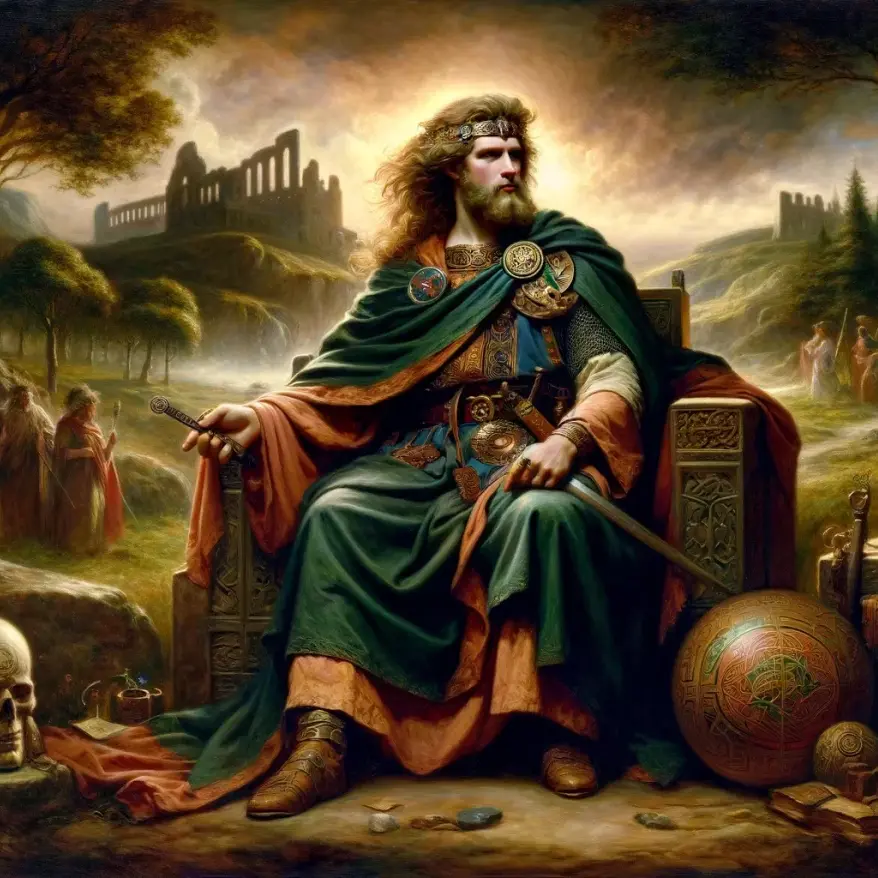
Lleu Llaw GyffesHero of the Fourth Branch of the Mabinogi, Lleu Llaw Gyffes is a skilled, bright youth shaped by curses, clever magic, betrayal, and hard-won sovereignty. steps into the Fourth Branch of the Mabinogion as a youth both gifted and constrained. His very birth is met with denial; his mother ArianrhodWelsh lady of sovereignty and magic whose name evokes the ‘silver wheel.’ Arianrhod presides over initiation, restriction, and the forging of identity. more... refuses him a name, arms, or a human wife. Through the cunning of his uncle and foster-father GwydionTrickster-mage of the Mabinogi whose cleverness makes and unmakes fates. creator of Blodeuwedd and tutor of Lleu. more..., Lleu gains each of these in turn. Yet every gift comes tangled with risk, and the path that leads him to kingship runs through curse, betrayal, and a near-death that leaves him briefly more eagle than man.
The name “Lleu Llaw Gyffes” means roughly “Lleu of the Skillful Hand” or “Sure-Handed Lleu,” and his story turns again and again on precision: the precise trick that forces Arianrhod to name him, the precise conditions that allow him to be killed, the precise spear-cast and stone-shield that mete out justice in the end. Where some heroes win by brute force, Lleu survives by a blend of crafted skill, careful timing, and the unwavering support of those who refuse to abandon him.
In the tale, Arianrhod lays three geasa on her son: that he will have no name, no arms, and no wife from among mortal women. Gwydion counters each curse with art. First he orchestrates a situation in which Arianrhod blurts out her son’s name, unwittingly fulfilling her own taboo. Later, he tricks her again into arming Lleu. Finally, when the third geisA personal vow or taboo carrying spiritual consequence if broken. It binds action to destiny and integrity. Observing a geas cultivates mindfulness of choice. blocks any human bride, Math and Gwydion fashion a woman from flowers: BlodeuweddFlower-born goddess of transformation whose tale of choice and consequence ends beneath the wings of night. more..., “Flower-Face.” For a time she and Lleu rule together in apparent harmony.
But harmony breaks. Blodeuwedd falls in love with Gronw Pebr and conspires to murder Lleu. Coaxing him into revealing the extremely specific conditions under which he can be killed, she weaponizes his trust. When the trap is sprung, Lleu is struck by a spear as he stands with one foot on a goat and one on the edge of a bath. Instead of dying outright, he transforms into a wounded eagle and flees, half-remembered and half-ruined, into the wild.
Gwydion finds him again by listening for poetry in the land: an eerie song over a valley, a wasting eagle perched in a tree above a pig-trail. Through chantA repeated phrase or melody used for focus and energy raising. Repetition deepens awareness and group cohesion. Chanting blends breath and charmA spoken or crafted expression of intent for protection he brings Lleu back to human shape. Only then can justice proceed. Gronw is slain by the same kind of carefully-aimed spear he used against Lleu, and Blodeuwedd is transformed into an owl, fated to be shunned by other birds. In the aftermath, Lleu takes his rightful place as ruler of Gwynedd. His sovereigntyThe principle of rightful authority grounded in balance and service. It ties leadership to harmony with the land and people. The concept stresses responsibility over... arrives not as an unchallenged inheritance, but as something tempered in fire, betrayal, and hard repair.
Why does Lleu matter for modern practitioners? Because his story speaks to anyone whose identity has been constrained, denied, or named only under pressure. He embodies the work of becoming oneself in the face of family wounds and social expectations. His “skillful hand” is not only martial; it is the steady grip on one’s own story after others have tried to write it for you. In devotion, Lleu often resonates with those rebuilding their lives after betrayal, reclaiming confidence after humiliation, or stepping into leadership they did not feel fully allowed to claim.
To approach Lleu, consider practices that blend skill, timing, and integrity. Train a craft with real discipline. Keep an oath you have delayed because it felt uncomfortable. If you have been wronged, do the slow work of seeking justice without becoming what harmed you. Offerings might include time spent honing accuracy.. such as a well-aimed throw, a carefully drafted letter, a cleanly executed project… or simple acts that protect the vulnerable from being used as pawns in others’ schemes.
For beginners, if you want a single image to carry, imagine a bright youth standing on uncertain footing with one foot on earth and one on the thresholdA physical or symbolic boundary between one state and another. Crossing it represents entry into new experience. Awareness of thresholds cultivates mindfulness. and holding a spear with unwavering precision. Around him swirl curses, plots, and transformations, but his hand does not shake. That is Lleu Llaw Gyffes: the part of us that insists on becoming who we are, even when the conditions are stacked against us, and that refuses to confuse survival with surrender.