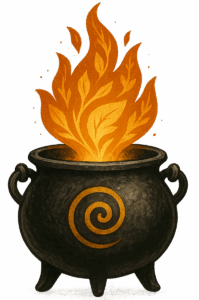
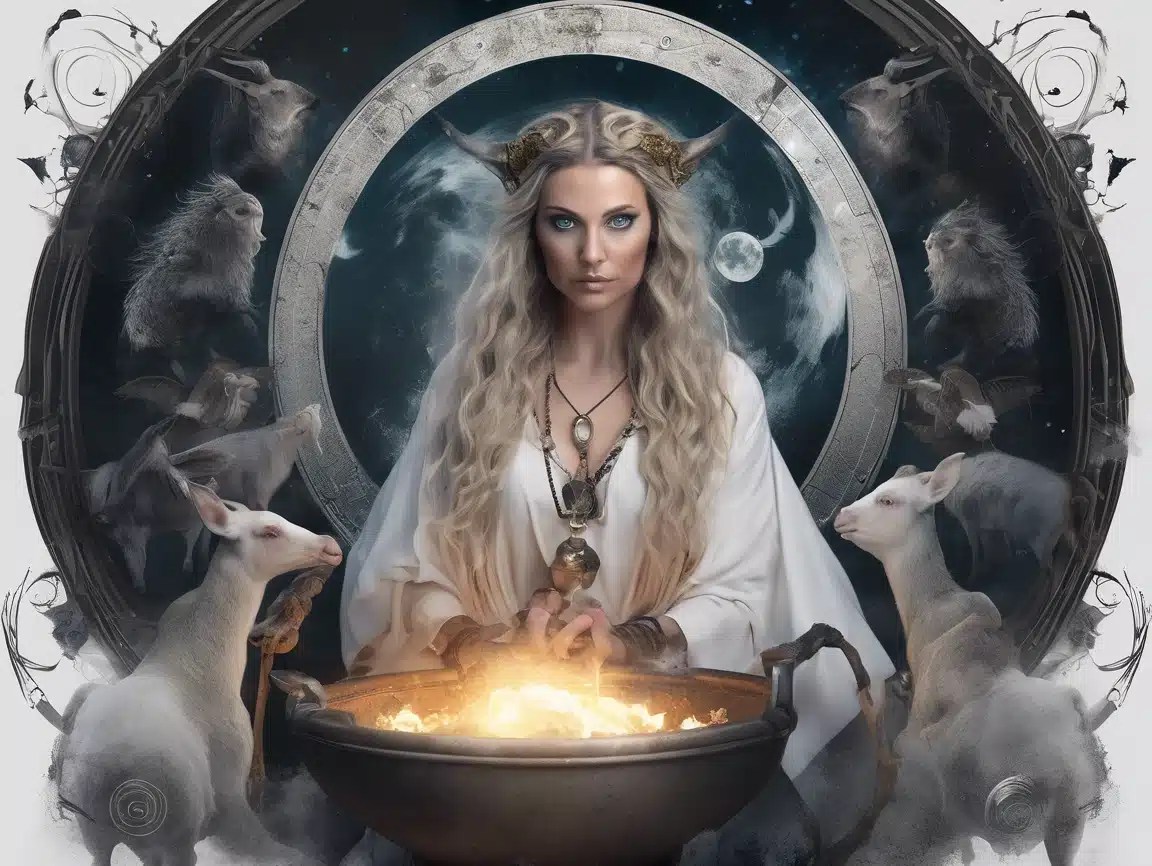
Among the figures of Welsh mythology, none embodies transformation as fully as CerridwenCeridwen is the Welsh goddess of transformation and inspiration, keeper of the cauldron of Awen, the divine poetic inspiration. Through her, wisdom is brewed, death... more..., the keeper of the cauldronA large vessel representing transformation of inspiration. She is both witch and mother, terror and teacher, darkness and dawn. To encounter her is to be unmade and remade… and not through gentle blessingA physical or verbal act that invokes divine energy to bestow protection, health, or good fortune upon a person, place, or event. In Druidry and... more..., but through the fierce alchemy of change.
Her story begins with love: Cerridwen wishes to grant wisdom to her son Afagddu, whose body is strong but mind dull. To brew enlightenment for him, she gathers herbs under the moon and sets her cauldron to boil for a year and a dayA traditional period of study or commitment before advancement or initiation. It ensures readiness and reflection. The timeframe balances patience and progress.. The potion is not magic in the crude sense; it is the slow art of transformation, the patient distillation of experience. Wisdom, she teaches, cannot be rushed.
Gwion Bach, initially a minor figure in the story, is set to the mundane task of stirring the cauldron. Yet, destiny alters his role dramatically when he accidentally ingests three drops of this potent brew. These drops are meant for Cerridwen’s son, but instead, they endow Gwion Bach with the AwenA Welsh term used in Druidry and Celtic spirituality to describe divine inspiration and creativity. It is symbolized by three rays of light, representing the... more..., a divine spark of wisdom and inspiration. This sudden enlightenment marks a pivotal turn in the narrative, illustrating the unpredictable nature of fate and the transformative power of divine knowledge. Realizing the magnitude of what has transpired, and the loss of the precious gift intended for her son, Cerridwen’s reaction is fierce and immediate. Her pursuit of Gwion Bach initiates a spectacular metamorphic chase, a motif common in Celtic storytelling, which highlights the fluid boundaries between forms and the interconnectedness of all life. As Gwion transforms into a hare, a fish, and a bird in attempts to escape the consequences of his actions, Cerridwen mirrors his transformations, becoming in turn a greyhound, an otter, and a hawk. The chase culminates in Gwion’s final transformation into a single grain of wheat, an act of desperation. Cerridwen, relentless and determined, transforms into a hen and consumes him, completing the cycle of pursuit. However, this is not the end for Gwion Bach. Instead, it leads to his rebirth as Taliesin, marking his transcendence from a mere bystander to an active participant in the cosmic drama. Taliesin emerges as a radiant poet-prophet, a symbol of wisdom and enlightenment reborn from the womb of Cerridwen, herself a representation of the nurturing yet formidable force of nature.
The myth, at its core, is about transformation through ordeal. Cerridwen is not a villain but a divine force that ensures every awakening has its price. Her pursuit is the friction of evolution, the chase of self becoming self. In swallowing Gwion, she becomes the womb of rebirth, giving back to the world what was taken by chance but made sacred by purpose.
Spiritually, Cerridwen represents the cauldron each of us must enter: the dark interior where ignorance is boiled away and understanding emerges. She is the night of gestation before dawn, the silence before the poem, the death before the song. To follow her path is to accept that creation demands dissolution and that to become wise, one must first be undone.
In bardic and Druidic tradition, her cauldron became the symbol of Awen, which is the flow of inspiration that unites poet, prophet, and creator. To drink from it is to see with divine eyes, but to prepare it requires labor and patience. Cerridwen reminds us that inspiration is earned, not gifted, and that every song, spell, or insight is brewed from the raw material of one’s own life.
She stands in contrast to the shining BrigidGoddess of healing, poetry, and craft; a bright, many-skilled patron of hearth and inspiration. Brigid bridges sacred fire and fresh water, blessing poets, healers, smiths,... more..., who inspires through fire and grace. Cerridwen’s way is lunar, watery, hidden. She teaches through immersion rather than illumination. Her wisdom arises from the depths, not the heavens. In her cauldron, all opposites dissolve, masculine and feminine, life and death, creator and creation… until only truth remains.
For the modern practitioner, Cerridwen is a goddess of study, transformation, and personal truth. She demands honesty and rewards persistence. To honor her is to engage deeply with one’s own becoming. To write, craft, or live with intentionA clear statement of purpose guiding thought and action. It directs energy toward desired outcome. Mindful intention shapes experience.. Her cauldron still simmers wherever someone seeks meaning in the dark.
She is not gentle, but she is just. Cerridwen reminds us that wisdom is not a something that can be gained or possessed. It is a process that one must go through… and that every soul must enter the cauldron, endure the heat, and rise again, reborn with eyes that see.