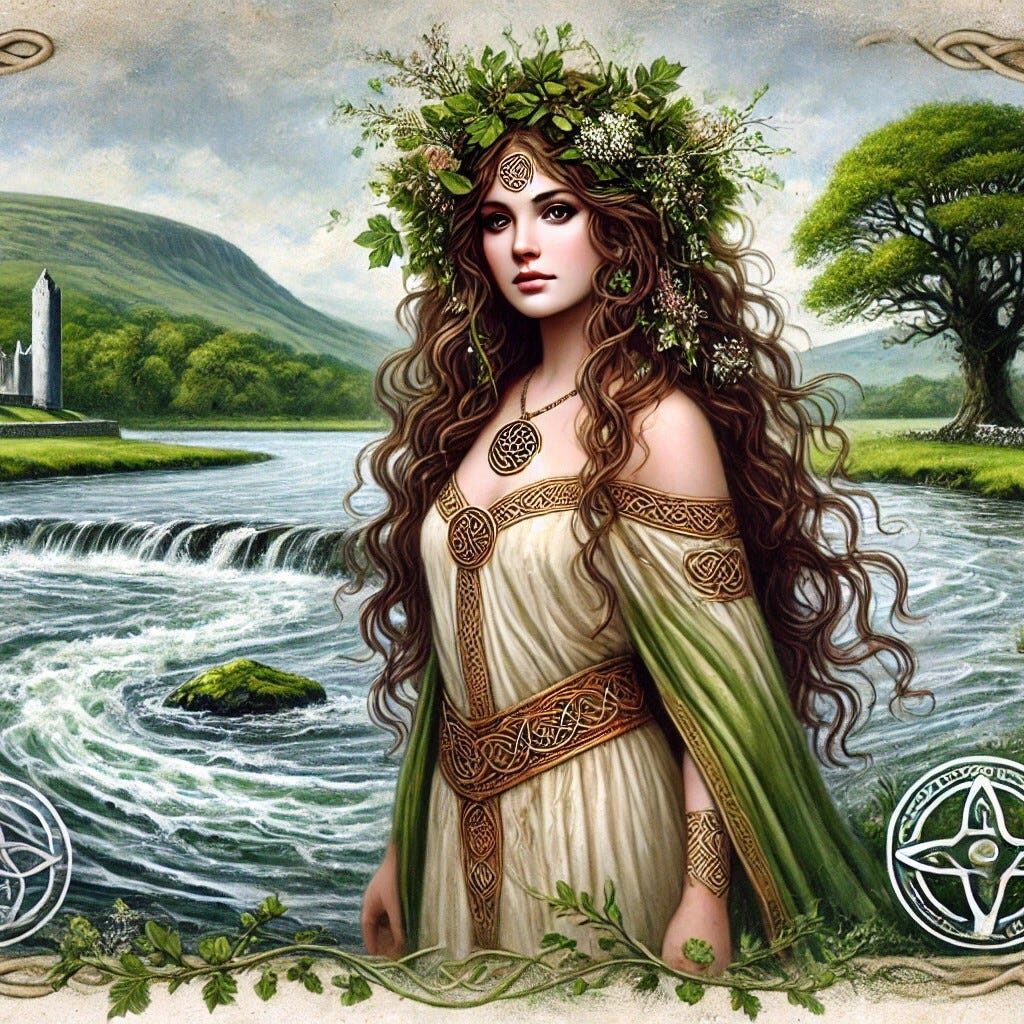
BoannGoddess of the River Boyne, associated with inspiration, fertility, and the generous flow that nourishes both land and story. Mother of Aengus by the Dagda. more... is the goddess of the River Boyne, a figure where poetry, fertility, and landscape flow together. Her stories speak of a sacred well under taboo and of a courageous approach that changes everything. When Boann walks around the well contrary to the rule, the waters surge after her, carving a path that becomes the Boyne and carrying knowledge out into the world. Some tellings present this as punishment; others see revelation: wisdom wants to move. A sealed spring may be safe, but a river feeds fields, cattle, and minds.
Boann’s union with the DagdaGreat king and master of abundance, the Dagda wields a cauldron that never runs empty, a club that kills and revives, and a harp that... more... produces Aengus mac ÓgPoetic, youthful god of love and dream-vision, son of the Dagda and the river goddess Boann. Aengus charms with hospitality and cunning, guiding seekers toward... more..., the youthful god of love and dreams, linking the river to the feast, the poem to the hearth. Their home at Brú na Bóinne anchors this theology of flow: winter sunlight enters the mound, and the river encircles it, a marriage of light and water. In iconography Boann is associated with white cows, sacred wells, and the bright curve of the Boyne; she is a patron of artisans whose work nourishes the community like irrigation.
For newcomers, Boann is a guide to the creative process. Drafts kept hidden stagnate; work released,like water,finds its way to those who need it. To honor her, pour a libationThe pouring of liquid such as wine of clean water at the roots of a tree, share a finished piece of writing, support river restoration, or begin a practice that keeps ideas moving from head to hand to world. In households she blesses kitchens and studios where making becomes a form of generosity.
Boann’s relationships emphasize kinship and care. As mother of Aengus she stands close to the Dagda’s abundance; as a river power she resonates with Danu’s nourishing matronage. Her story also carries a caution: boundaries around holy things matter, yet the point of holiness is not hoarding. The well’s secret becomes a river precisely so life can flourish downstream. That is a sharp lesson for creators who fear sharing their work,Boann smiles and says, “Let it flow.”
Historically, the Boyne valley is dense with monuments and memory, and it is fair to imagine that a living cult once honored Boann and her waters. Today, to walk along the river’s bend or stand at Newgrange is to feel how landscape participates in myth. If you want a simple mnemonic, remember: well → river.Trickster-mage of the Mabinogi whose cleverness makes and unmakes fates. creator of Blodeuwedd and tutor of Lleu. more... Where the well is honored, the river remembers its path,and where the river runs, stories grow.