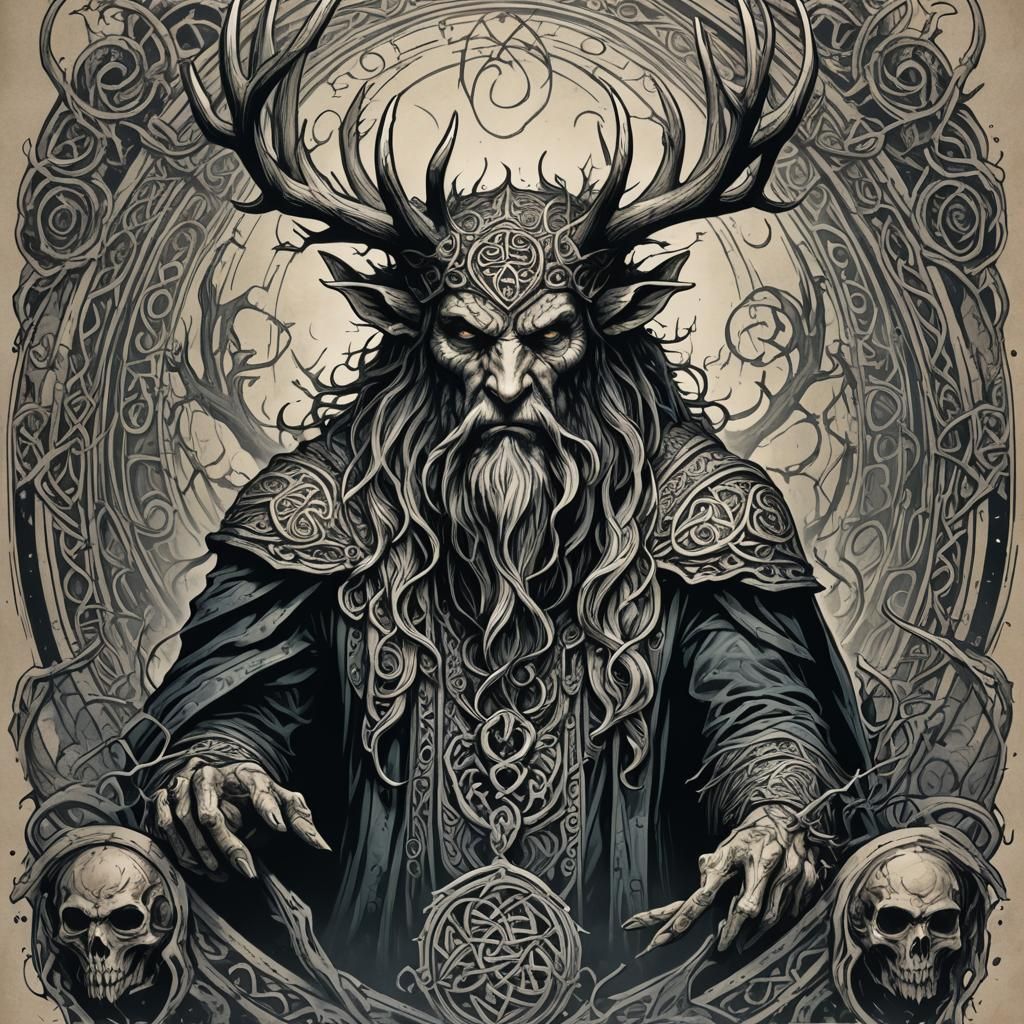
ArawnLord of Annwn, the Welsh Otherworld, who rules with justice and hospitality. Arawn tests character, rewards honor, and stands at the crossing between life and... more..., King of Annwfn, stands among the most misunderstood figures of Celtic myth. To the uninitiated, he might appear as a ruler of the dead, yet in truth he is the sovereign of balanc… the one who ensures that cycles complete, that beginnings and endings remain in harmony. His kingdom, Annwfn, is not hell but perfection’s mirror: a realm of beauty, mystery, and timelessness. Where mortal lands are fragile and fleeting, Annwfn endures, reflecting the eternal structure of the soul’s journey.
In the Mabinogi, when Pwyll of Dyfed offends Arawn by poaching in his Otherworldly hunting grounds, the god does not destroy him. Instead, he offers a test, an exchange of lives for a year and a dayA traditional period of study or commitment before advancement or initiation. It ensures readiness and reflection. The timeframe balances patience and progress.. In Arawn’s form, Pwyll must fight Hafgan, Arawn’s rival, and can strike only once. Temptation surrounds him: power, desire, deception. Yet Pwyll holds true, honoring every condition. When the year ends, Arawn finds that the mortal not only obeyed his word but preserved his wife’s honor as well. Gratitude replaces wrath; friendship replaces enmity.
This exchange reveals the heart of Arawn’s domain, it is not death that defines him, it’s integrity. His OtherworldThe Celtic spiritual realm intertwined with the mortal world. It is a place of ancestors is the crucible in which truth is tested and refined. Those who enter it face not punishment, but reflection. In that mirror, all masks fall away. Arawn’s justice is impartial and absolute: what you are, you become.
Over time, folklore reshaped him into a spectral figure, leader of the Cŵn Annwn, the ghostly hounds whose cries echo through the hills on stormy nights. Yet even this image holds dignity. The hounds’ white coats and red ears mark them as Otherworldly, symbols of purity and transformation. When they hunt, it is not the living they chase… it’s the dying, guiding souls across the veilThe subtle boundary separating physical and spiritual perception. It thins during certain times or states of awareness. The image of the veil expresses mystery and.... Arawn, then, is not the taker of life but its guardian, ensuring that no spirit is lost in the dark between worlds.
Spiritually, Arawn represents the Druidic principle of awenA Welsh term used in Druidry and Celtic spirituality to describe divine inspiration and creativity. It is symbolized by three rays of light, representing the... more... through ordeal, the wisdom earned by confronting one’s own shadow. He is the keeper of right relationship: between promise and fulfillment, will and consequence, self and soul. To invoke him is to call for balance, truth, and the courage to honor one’s oaths even when no one watches.
Modern devotees might find him in the hush of dusk, the moment when the world grows still and boundaries blur. He speaks through the scent of rain on stone, through the presence of a black hound pausing at the edge of the woods, through the silence that follows honest speech. His rites are simple but bindingThe act of limiting harmful action or influence through symbolic means. It prevents interference without aggression. The practice emphasizes restraint and justice.: act with fairness, keep your word, honor the unseen.
Arawn’s lesson is not that darkness is to be feared, but that it must be respected. He teaches that endings, when met with honor, are also beginnings, that the door to Annwfn is the same door through which light returns. In him, death is not punishment but fulfillment: the world exhaling so it may breathe again